
Let’s get one thing straight right out of the gate: if you are in the commercial tent rental industry, you aren’t just renting out structures for weddings, corporate events, and festivals. You are in the business of managing rapidly depreciating capital assets. Your inventory—the vinyl tops, the sidewalls, the keders, the webbing—represents the largest continuous capital expenditure (CapEx) on your balance sheet. How you maintain that vinyl dictates your profit margins, your labor overhead, your turnaround times, and ultimately, the lifespan of your business.
When we started out as a rental company decades ago, we learned these lessons the hard way. We spent thousands of agonizing labor hours scrubbing tents on concrete floors, watching our pristine white vinyl turn dull, chalky, and yellow. We watched our profits drain down the wash bay floor. That’s exactly why Teeco Solutions pivoted to engineering and manufacturing industrial washing solutions. We don’t just build machines; we build operational leverage for rental operators. We build equipment designed to protect your assets and boost your bottom line.
This guide isn’t a fluffy marketing brochure. It is the definitive, industry-standard manual on the mechanics, chemistry, and operational logistics of preserving commercial tent vinyl. We are going to dive deep into the science of cleaning, the catastrophic damage caused by improper techniques, the unvarnished truth about hand washing versus machine washing, and the critical importance of moisture control.
If you want to scale a multi-location operation, dominate your market, and stop replacing your inventory every two to three seasons, read this manual. Train your crew with it. Implement it as your standard operating procedure. Let’s get into the mechanics.

Part 1: The Economics of Tent Maintenance and ROI
Before we talk about pH levels and tumble dynamics, we have to talk about the money. In today’s economic climate, labor shortages are the standard, not the exception. The cost of a dependable warehouse crew is at an all-time high, and the availability of that crew is at an all-time low.
When you mismanage your tent cleaning operations, you are bleeding money in three distinct areas:
- Premature Asset Replacement: A commercial tent top should yield a strong ROI over 5 to 10 years depending on deployment frequency. If your cleaning methods are destroying the UV topcoat and plasticizers, that lifespan shrinks to 2 to 3 years. You are doubling your CapEx.
- Wasted Labor Hours: Paying three guys $20+ an hour to push floor buffers over a 60×120 top for six hours is not just expensive; it’s an egregious misuse of human capital. That crew should be pulling orders, loading trucks, or performing maintenance on revenue-generating equipment.
- Lost Revenue from Unrentable Inventory: A tent with permanent mold staining or ground-in dirt cannot be rented for a high-ticket, Grade-A wedding. It gets downgraded to a “B” or “C” grade tent (festival or construction use), drastically reducing its rental rate.
Proper maintenance isn’t just a chore; it is an active profit-protection strategy. Teeco Solutions looks at cleaning through the lens of ROI. Every gallon of chemical, every minute of wash time, and every degree of water temperature must be calibrated to maximize the lifespan of the fabric while minimizing the labor input.
Part 2: The Chemistry of Cleaning – Protecting Your Vinyl
To understand how to clean a tent, you have to understand what a tent is actually made of. Commercial tent fabric isn’t just “plastic.” It is a highly engineered composite material consisting of a central polyester reinforcing mesh (the scrim) sandwiched between layers of Polyvinyl Chloride (PVC) film.
By its nature, raw PVC is rigid and brittle (think of PVC plumbing pipes). To make it flexible enough to fold, roll, and stretch over a frame, manufacturers infuse it with chemical additives called plasticizers (typically phthalates). Finally, a protective topcoat—usually an acrylic or PVDF (polyvinylidene fluoride) lacquer—is applied to seal the surface, provide a glossy finish, repel dirt, and block UV degradation.
Why Near-Neutral pH Cleaning Agents are Non-Negotiable
When you bring a dirty tent into the wash bay, the goal is to break the bond between the particulate soil and the surface of the vinyl without breaking the chemical bonds of the vinyl itself. This requires a near-neutral pH cleaning agent formulated specifically for PVC.
A near-neutral pH detergent uses advanced surfactants (surface-active agents). Surfactants work by lowering the surface tension of water, allowing it to penetrate the microscopic layer of dirt, encapsulate the soil particles, and lift them into suspension so they can be rinsed away. Because the pH is neutral, the chemical does not react with the plasticizers or the acrylic topcoat. It simply removes the dirt.
The Silent Killers: Heavy Solvents, Degreasers, and Bleach
The biggest mistake rental operators make—often out of desperation during the busy season—is reaching for heavy-duty industrial degreasers, harsh solvents, or bleach to cut through stubborn stains. Products like heavy purple degreasers, citrus-based solvents, and chlorine bleach are highly alkaline (high pH) or highly acidic (low pH) and act as corrosive agents on PVC.
Here is the exact chemical breakdown of what happens when you use these aggressive agents on your inventory:
- Plasticizer Migration and Extraction: Heavy solvents and high-pH degreasers actually dissolve the plasticizers that give your tent its flexibility. When the plasticizers are leached out of the PVC, causing rapid plasticizer migration and extraction, which leads directly to PVC embrittlement and crackingthe material undergoes a process called embrittlement. The tent becomes stiff, difficult to fold in cold weather, and highly prone to pinholes, cracking, and tearing at the stress points.
- Destruction of the UV Topcoat: Highly alkaline cleaners strip the protective acrylic or PVDF topcoat right off the fabric. Once that topcoat is gone, the raw, porous PVC is exposed to the elements. Without its UV shield, the tent will begin to chalk (a powdery white residue on the surface) and turn permanently yellow when exposed to the sun.
- Bleach and Scrim Degradation: Chlorine bleach is often used by desperate crews trying to kill mold. While bleach will turn the mold white (making it invisible), it is highly oxidative. Bleach attacks the internal polyester scrim if it seeps into pinholes or unsealed seams. It rots the structural integrity of the tent from the inside out, leading to catastrophic failure under wind loads. Furthermore, bleach degrades the thread used in the stitching, drastically reducing the fabric’s grab tensile and seam strength as measured by ASTM D751 standards for coated fabrics, causing seams to blow out prematurely.
The Teeco Standard: We formulated our proprietary Teeco tent cleaning solutions to operate in that safe, near-neutral pH zone. It relies on sophisticated surfactant chemistry rather than brute-force alkalinity. It preserves your topcoat, locks in your plasticizers, and ensures your vinyl remains supple, glossy, and structural sound for years.
Part 3: The Dangers of Abrasive Scrubbing – The Microscopic Truth
Walk into almost any startup rental company’s wash bay, and you will see it: a crew of guys on their hands and knees using abrasive sponges, or worse, someone operating a heavy rotary floor buffer equipped with a red, green, or black stripping pad, grinding away at the vinyl.
They think they are doing a good job because the dirt is coming off. What they don’t realize is that they are systematically destroying the asset.
The Mechanics of Microscopic Pitting
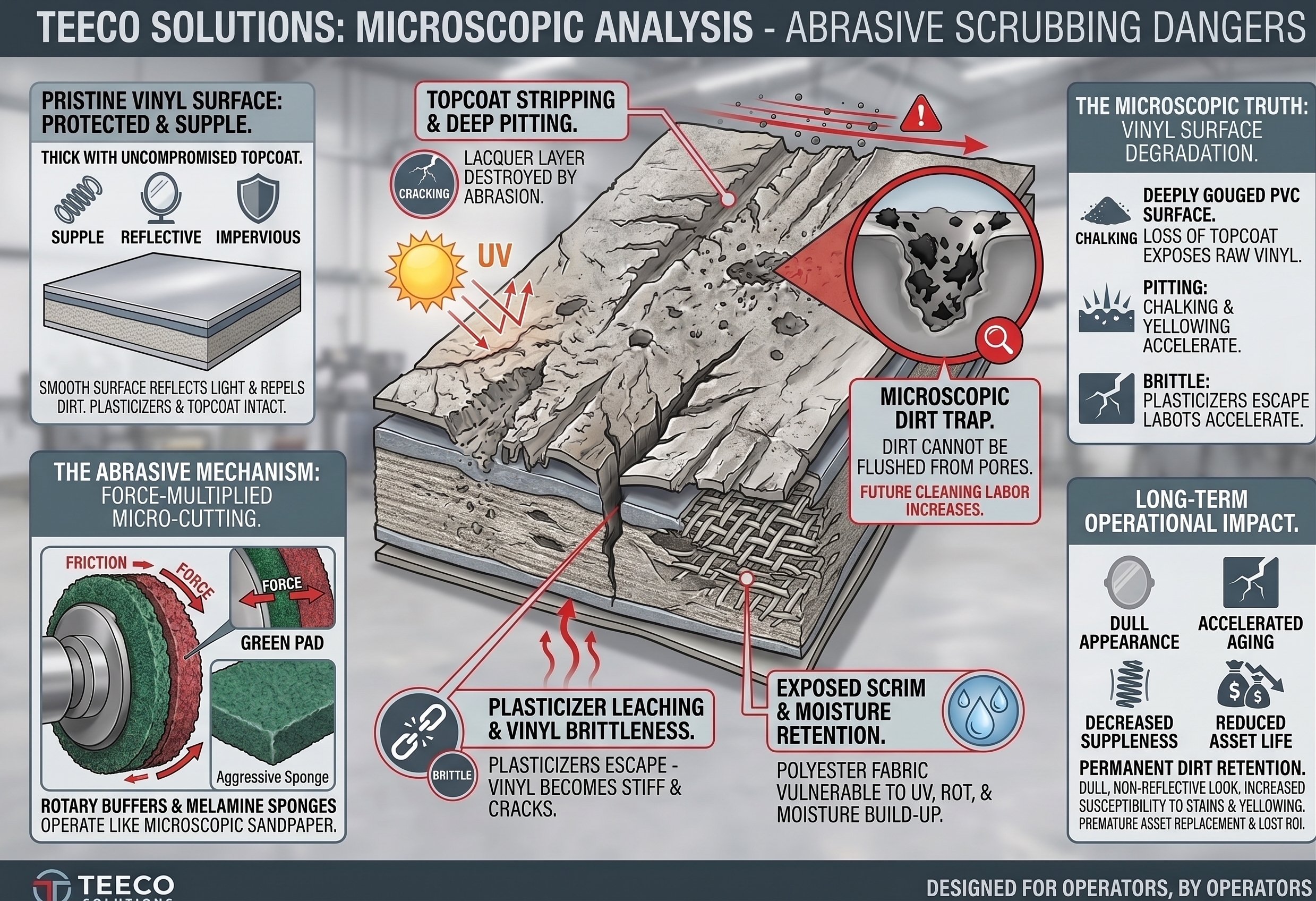
To the naked eye, a tent top looks flat and smooth. Under a microscope, vinyl has a specific topography. The protective topcoat creates a continuous, sealed surface. When you introduce an abrasive mechanical action—whether it’s a floor buffer, a stiff-bristled deck brush, or a melamine foam pad (like a “Magic Eraser”)—you are effectively taking sandpaper to a clear-coated car.
- Stripping the Lacquer: Floor buffer pads are designed to strip wax off concrete and VCT tile. When applied to tent vinyl, they immediately grind off the acrylic topcoat.
- Micro-Scratches and Pitting: Once the topcoat is compromised, the abrasive pad gouges microscopic scratches and pits into the underlying PVC.
- The Vicious Cycle of Dirt Retention: This is where the long-term operational damage occurs. A scratched, pitted tent surface has thousands of microscopic valleys. The next time that tent goes out on a job, airborne dust, exhaust fumes, and pollen settle directly into those deep scratches. Because the dirt is now embedded deep within the texture of the damaged vinyl, a simple wipe-down or gentle wash will no longer remove it.
The Escalation of Force
Because the tent gets dirtier faster and is harder to clean, the wash bay crew assumes they need to scrub harder the next time. They use a more aggressive pad. They use a harsher chemical. They grind deeper into the vinyl.
Eventually, the fabric becomes a dull, porous, greyish-white sponge that absorbs dirt on contact. The tent looks terrible, it feels terrible, and it is impossible to clean. You are forced to downgrade the tent to “B” stock long before its time.
The Teeco Solution: Proper cleaning requires chemical dwell time and non-abrasive mechanical action. You must let the near-neutral chemicals do the heavy lifting to emulsify the dirt. The mechanical action should only serve to agitate the suspended soil, not to grind the surface. This is why transitioning from hand-scrubbing to the engineered friction of a dedicated tent washing machine is the most critical operational upgrade a rental company can make.
Part 4: Hand Washing vs. Machine Washing Dynamics
Let’s talk operations. As your inventory grows from a few 20x20s to massive clearspans, structure tents, and hundreds of traditional pole and frame tents, hand washing becomes mathematically and physically unsustainable. We need to look objectively at the mechanics and economics of hand washing versus utilizing a Teeco industrial tent washer.
The Reality of Hand Washing
Hand washing is inherently flawed for three main reasons: it is inconsistent, it is physically exhausting, and it is incapable of cleaning the complex geometries of a commercial tent.
- Inconsistency and Fatigue: Your crew starts the day strong. The first tent might get a decent scrubbing. But pushing a brush or a buffer over thousands of square feet of heavy, wet vinyl is backbreaking labor. By 2:00 PM, fatigue sets in. Corners are cut. The center of the tent might look okay, but the perimeters are ignored. You end up with an inventory of inconsistently cleaned assets.
- The Anatomy of a Tent – Where Hand Washing Fails: A tent is not a flat sheet of plastic. It features intricately sewn webbing, heavy-duty Velcro lace lines, keder edges (the thick rope edging that slides into aluminum tracks), grommets, and complex stitching.
- Webbing and Velcro: Hand brushing merely glides over the top of heavy webbing and Velcro. It cannot penetrate the woven fibers where dirt, mud, and grass stains get deeply embedded.
- Lace Lines: The overlapping flaps of lace lines are notoriously difficult to clean by hand, often remaining filthy even after hours of labor.
- Keder: Keder tracks pick up aluminum dust and black oxidation from the frame. Hand scrubbing rarely removes this embedded grime.
The Mechanics of a Teeco Industrial Washer
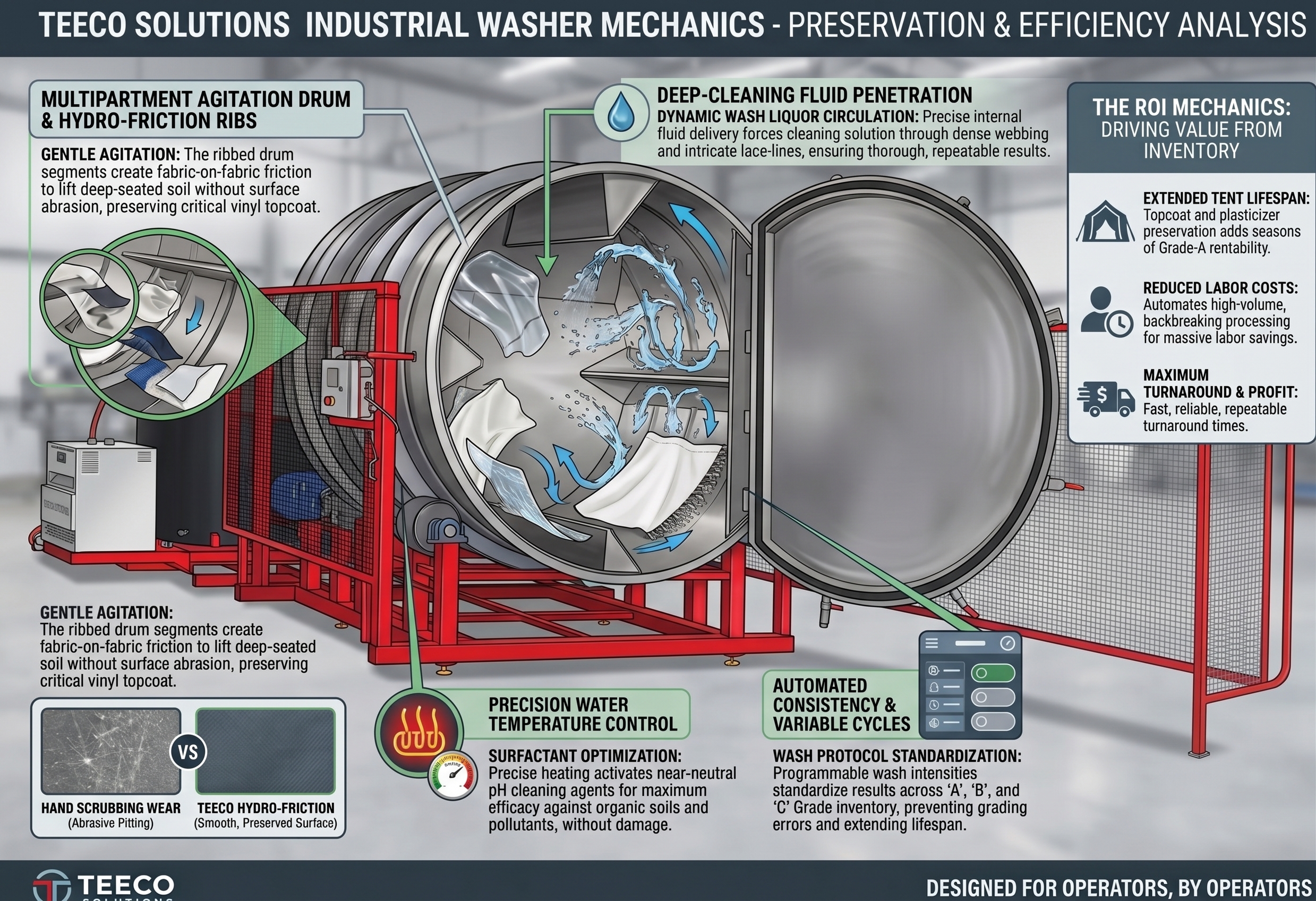
We engineered Teeco tent washers to solve these exact mechanical problems. When you put a tent into an industrial washer, you are fundamentally changing the physics of the cleaning process.
- Tumble Action and Aqueous Dynamics: A Teeco washer utilizes a massive, specially designed stainless steel drum. As the drum rotates, the tent is lifted and dropped through the wash liquor (the precisely heated water and near-neutral detergent mixture). This tumbling action forces the cleaning solution through every fold, every seam, and every fiber of the tent.
- Hydro-Friction without Abrasion: The machine cleans through fluid dynamics and fabric-on-fabric friction. As the heavy vinyl folds over itself in the water, it gently agitates the dirt loose. There are no abrasive pads, no harsh bristles. The friction is entirely non-destructive, preserving the topcoat and the plasticizers.
- Deep Cleaning the Intricacies: This is where the machine truly dominates. The continuous tumbling forces water and detergent straight through the heavy webbing, flushing out the mud from the inside out. It cleans the hook-and-loop Velcro thoroughly, restoring its grip. It scours the keder rope, removing aluminum dust.
- Temperature Control: Heat is a critical component of the cleaning triad (Chemical, Mechanical Action, Temperature). Teeco washers allow you to control the water temperature perfectly. Warm water exponentially increases the effectiveness of the surfactants, melting away organic oils, leaf sap, and environmental pollutants that cold water hand-washing simply cannot touch.
The End-of-Season Turnaround and Labor Allocation
Think about your peak season. Turnarounds are measured in hours, not days. A crew of four might take three hours to hand-wash and hang a large structure top. That is 12 man-hours of labor for one piece of vinyl.
With a Teeco machine, one operator loads the tent, presses start, and walks away. For the next hour, while the machine does the hard work, that operator is free to patch tarps, load trucks for the next job, organize chairs, or perform inventory counts. When the cycle finishes, the tent is exponentially cleaner than it would have been by hand, and you have reclaimed 11 hours of labor.
At $20 an hour, you just saved $220 on one wash cycle. Run a Teeco machine 10 times a week during your busy season, and the machine pays for itself in labor savings and asset preservation with shocking speed. We are talking about genuine operational leverage.
Part 5: The Critical Importance of Complete Drying
We have discussed how to safely and effectively clean the vinyl. But the process is only half finished when the tent comes out of the washer. If there is one topic in this guide that I need you to memorize, it is this: Moisture is the ultimate destroyer of commercial tents.
Dedicating time, labor, and chemical to perfectly wash a tent, only to pack it away wet or damp, is a fatal operational error. You are signing a death warrant for that asset.
The Biology of Mold and Mildew
Tents are often subjected to extreme environmental conditions—rain, humidity, ground moisture, and organic debris like leaves and grass. When a tent is folded and bagged while still containing trapped moisture, you create a perfect microclimate for biological growth. The dark, warm, damp environment inside a tent bag is a literal incubator for mold and mildew spores.
- Surface Mold vs. Intrinsic Mold (Pinking/Ghosting):
Surface mildew (often black or green) can generally be washed off if caught early. The true danger is when the biological growth penetrates the vinyl. If your vinyl has been previously compromised by abrasive scrubbing or chemical burns, the mold roots itself directly into the internal polyester scrim. - Mycotoxins and Permanent Staining: As certain types of bacteria and mold digest the plasticizers and organic matter, they excrete by-products (often referred to as mycotoxins). One of the most notorious in the rental industry is the bacteria Streptoverticillium reticulum, which produces a bright pink or purple dye. This dye permanently stains the PVC from the inside out. This is known in the industry as “pinking” or “ghosting.”
- The Point of No Return: Once a tent has pinked, no amount of bleach, scrubbing, or magic chemicals will remove it. The dye is chemically bonded to the polymer chains of the vinyl. The top is ruined. You can only use it for low-grade industrial rentals or throw it in the dumpster.
The Logistics of Complete Drying
Drying is often the biggest bottleneck in a rental operation. Operators complain they don’t have the ceiling height, the warehouse square footage, or the time to dry tents properly. But skipping this step is not an option.
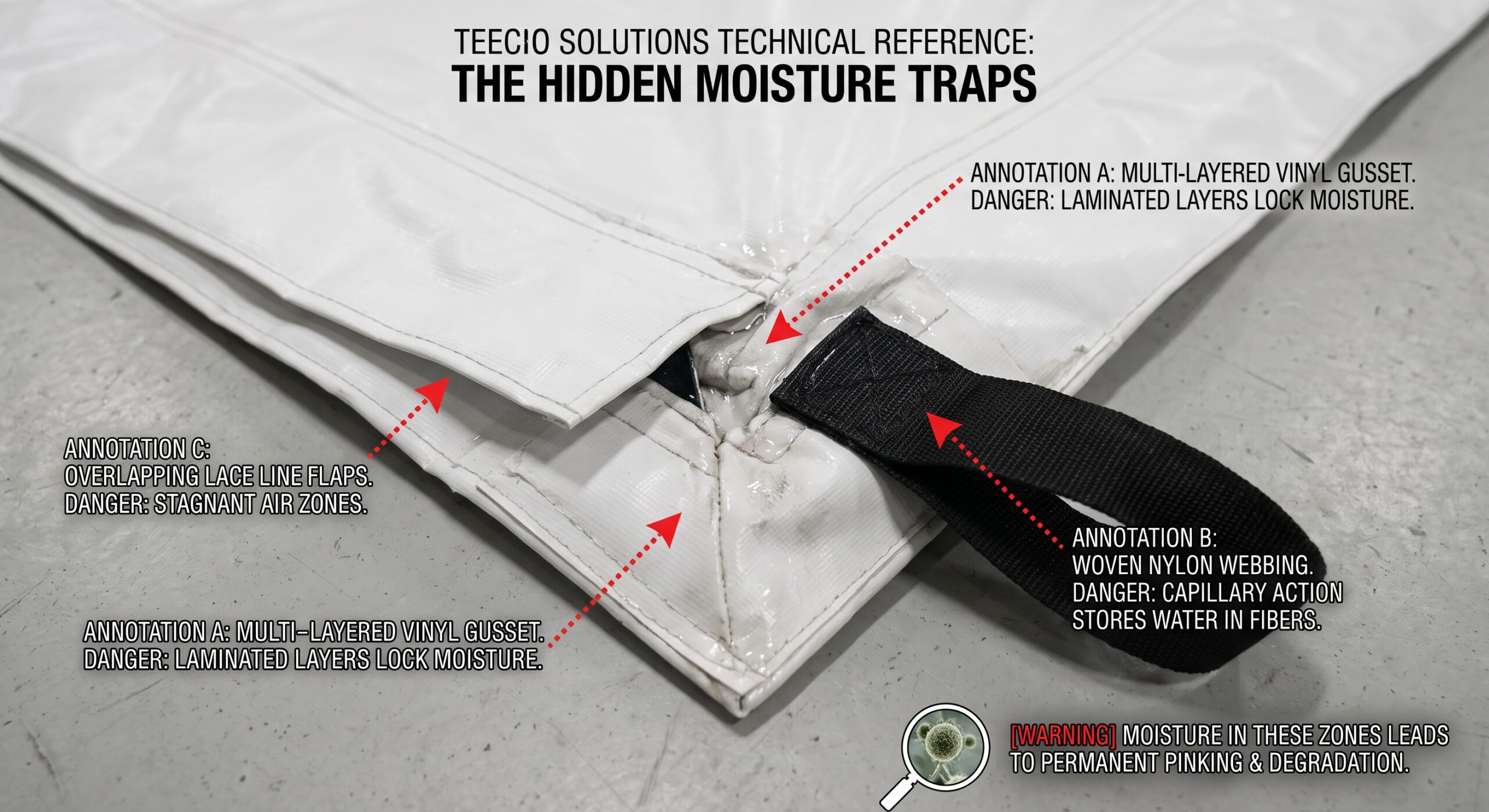
- Hanging and Airflow: If you are air-drying, tents must be hoisted high enough that they do not bunch on the floor. You must introduce massive airflow using industrial drum fans. Stagnant air allows pockets of moisture to remain in the lace lines, the webbing, and the reinforced corner gussets.
- Dehumidification: Moving air isn’t enough if the warehouse is 90% humidity. You must close the wash/dry bay and run commercial dehumidifiers to pull the moisture out of the air, lowering the vapor pressure so the water actually evaporates off the vinyl.
- The Hidden Moisture Traps: The flat panels of vinyl dry quickly. The danger zones are the heavy reinforcements. The multi-layered vinyl at the corner plates, the thick nylon webbing, and the heavy seams hold water for days. A tent may feel dry to the touch in the center, but if the webbing is damp when you roll it up, mold will spread from those seams outward.
Overcoming the Bottleneck: Industrial Machine Drying
Because drying is such a massive operational bottleneck, relying on air-drying often grinds a busy rental business to a halt. You literally run out of space to process inventory.
This is why serious operators pair their Teeco washers with Teeco industrial tent dryers. Just as tumble washing revolutionized the cleaning process, tumble drying revolutionizes the turnaround time.
- Controlled Heat and Airflow: Our dryers utilize a massive, perforated drum and force high volumes of precisely heated air through the tumbling vinyl.
- Reaching the Danger Zones: The tumbling action continuously exposes every fold, every seam, and every heavy webbed corner to the heated air. Moisture is evaporated rapidly and exhausted out of the building.
- Bone-Dry Guarantee: A tent that takes 48 hours to air-dry in a humid warehouse can be bone-dry, safely sterilized by the heat, and ready to bag in less than an hour in a Teeco dryer.
By implementing a wash-and-dry mechanical system, you create a continuous, predictable processing loop. A dirty tent comes off the truck, goes into the washer, transfers to the dryer, and is bagged, tagged, and put back on the shelf ready for rent on the exact same day. No hanging, no waiting on the weather, no mold anxiety.
Part 6: Building a Lifecycle Maintenance Program for Your Operation
To truly protect your assets, you must transition from a reactive mindset (“this tent is filthy, we better wash it”) to a proactive lifecycle maintenance program. You need to standardize your wash bay operations so that every piece of vinyl is treated with the same precision, whether you own ten tents or a thousand. You can start by aligning your wash bay SOPs with the maintenance standards set by the ATA Tent Rental Division.
1. Establish Standard Operating Procedures (SOPs)
Write down your wash bay procedures and mandate that every employee follows them. There should be no rogue decision-making regarding chemicals or tools.
- Banish the Bad Tools: Walk through your wash bay right now and throw every stiff deck brush, every red or black floor buffer pad, every magic eraser, and every jug of bleach directly into the garbage. If they aren’t in the building, your crew can’t use them.
- Standardize the Chemistry: Pre-mix your near-neutral Teeco cleaning solutions in bulk dispensing stations. This ensures the dilution ratios are perfect every time, preventing crew members from pouring raw concentrate directly onto the vinyl (wasting money and potentially shocking the material).
2. Implement the “End of Season” Deep Clean Protocol
During the peak summer and fall rush, you are doing “turnaround washes”—getting the worst of the mud off so the tent can go out the next day. But your business’s longevity relies on the End of Season Deep Clean.
Before a tent is put on the rack for the winter, it must be thoroughly deep-cleaned. This is where machine washing is mandatory. Every speck of organic matter, sap, and airborne pollutant must be purged from the webbing, seams, and Velcro. If you store a tent all winter with microscopic organic matter trapped in the fibers, it will degrade the material and invite pest damage or mold growth.
3. Log and Track Asset Degradation
Treat your vinyl like a fleet of delivery trucks. Track how many times a top has been deployed, when it was last deep-cleaned, and its current grade (A, B, or C).
When a tent comes out of a Teeco washer and dryer, your crew should conduct a fast, standardized inspection:
- Check the keder for fraying.
- Check the D-rings and O-rings for rust or bending.
- Check the lace lines for torn stitching.
- Check for pinholes (easily done by placing a bright light behind the fabric).
Repair these minor issues immediately. A small pinhole repaired today prevents a massive tear during a 40mph windstorm next month.
The Bottom Line: Partnering for the Long Haul
At Teeco Solutions, we look at the tent rental industry through the eyes of operators because that is exactly where we came from. We know what it feels like to have an entire crew tied up in the wash bay while the loading dock is backed up. We know the sinking feeling of unrolling a top in front of a high-paying bride, only to realize it is permanently stained with pink mold because it was packed away damp three weeks ago.
You are managing an operation with incredibly tight margins, high labor costs, and demanding clients. You cannot afford to treat your vinyl as a disposable commodity. Every time you extend the life of a tent by two additional seasons, that revenue drops straight to your bottom line as pure profit.
Protecting your inventory requires the right chemistry, the right mechanical action, and absolute moisture control. Stop relying on abrasive scrubbing and destructive chemicals. Stop bleeding labor hours on the wash bay floor.
We aren’t just here to sell you a machine or a bucket of soap. We are here to partner with you for the lifespan of your business, providing the engineered solutions you need to scale efficiently, protect your capital investments, and maximize your profitability.
Take Action on Your Inventory Today
Are you ready to stop grinding away your profits on the wash bay floor? It is time to audit your cleaning processes and upgrade your operations.
Schedule a Free Equipment Consultation Today
Speak directly with our team of rental industry veterans to discuss how a Teeco industrial washer and dryer setup can revolutionize your specific warehouse footprint and workflow.
Shop Teeco’s Near-Neutral Cleaning Solutions
Get the harsh solvents and bleach out of your building. Stock up on our proprietary, scientifically formulated tent cleaning agents designed to strip dirt and protect your plasticizers.
Your tents are your livelihood. Let Teeco Solutions help you protect them.